Why More OOH Delivery Networks Are Turning to Compact Sortation
Out‑of‑home (OOH) delivery isn’t just a trend anymore—it’s how a growing share of parcels get to customers. Locker networks and pickup points are expanding fast, while urban depots and micro‑fulfillment hubs are squeezed for space and headcount. The challenge is simple to describe and hard to solve: sort more parcels, to more precise destinations, in less space and time. Traditional, building‑sized sorters aren’t built for that world.
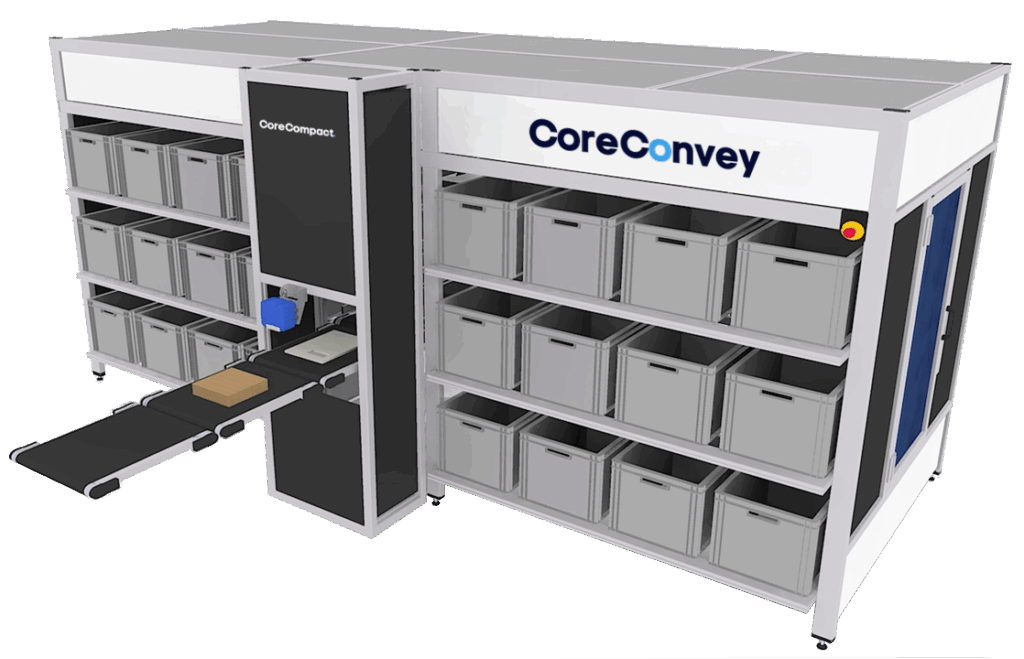
CoreCompact is. It’s a compact sortation unit that fits in a 4 × 2 m footprint, handles up to 1,500 items per hour, and offers up to 48 outputs per unit. You can run a single machine in a small site or network several to cover hundreds of destinations. For OOH providers and locker networks, that means sorting down to locker bank or even locker‑level bags—right next to the dispatch point.
Why compact sortation works for OOH
OOH operations need accuracy and granularity without the overhead of a giant system. With compact sortation you can:
- Sort closer to the customer. Put capacity where you need it—urban hubs, regional depots, or inside partner facilities.
- Scale in small steps. Start with one unit, add more as volume or destinations grow. No big leap in spend or space.
- Keep flows flexible. Reconfigure outputs for new routes, new locker sites, or seasonal swings without a rebuild.
Locker‑level sorting, done right
Locker deliveries live or die by first‑time success. CoreCompact lets you pre‑sort to route, driver, locker bank, or specific drop container. Operators can choose outputs that feed:
- Bags or totes labeled by locker bank or delivery round
- Roll cages or carts for specific zones
- Direct conveyor or chute feeds to packing and dispatch
The result: fewer handling steps, cleaner rounds for couriers, and fewer misses at the last mile.
Data you can trust (and use)
Sortation is only useful if the data is solid. CoreCompact ties into your systems through REST API or FTP, exchanging item IDs, routing codes, and status events in real time. Built‑in scanning, optional photo capture, and dimension/weight checks help verify each item before it leaves the lane. If something doesn’t match, the system flags it for exception handling instead of letting errors sneak through.
Fit and deployment
Space is tight in most OOH hubs. A single CoreCompact unit needs only 4 × 2 m and standard utilities. Installation is straightforward, and the layout can be mirrored or rotated to suit the room. Outputs can drop to tables, gravity rollers, bags, bins, or cages—whatever keeps your flow simple and ergonomic.
When one unit isn’t enough
Many networks need hundreds of destinations. Instead of one massive sorter, you can network multiple CoreCompact units. Each unit handles a slice of destinations (for example, routes 1–48, 49–96, and so on) while a central control layer coordinates the overall logic. This approach is easier to roll out, easier to maintain, and gives you redundancy—if one unit is offline, the rest keep working.
What operations teams notice first
- Lower manual effort. Fewer touchpoints and less walking between areas.
- Fewer mistakes. Each item is verified as it’s sorted.
- More parcels out the door. Throughput increases without a building project.
- Clearer visibility. Live status in your WMS/ERP means fewer “where is it?” calls.
Use cases we see often
- Dense locker grids in cities. Pre‑sort to locker bank or street segment for cleaner courier rounds.
- Regional depots feeding pickup points. Load cages per store or locker route to cut cross‑docking time.
- Returns hubs. Separate by merchant, condition, or next action with minimal handling.
- Peak season pop‑ups. Drop temporary capacity into small sites, then redeploy later.
Costs and ROI (the practical view)
Compact sortation is all about getting reliable speed where it matters. By moving from manual put walls or ad‑hoc sorting to CoreCompact, operators typically cut touches per parcel, reduce rework from mis‑sorts, and hold labor steady while volumes rise. Because units are modular, you scale spend with demand instead of betting on a single, oversized asset.
What makes CoreCompact different
- Small footprint, real throughput. Up to 1,500 items/hour without commandeering the whole site.
- Up to 48 outputs per unit. Enough lanes to sort at a meaningful level of granularity.
- Flexible outputs. Bags, bins, cages, rollers, or chutes—configure to your process.
- Simple integration. REST API or FTP to your WMS/ERP; real‑time events and reporting.
- Built‑in checks. Barcode, optional photo, and dimension/weight capture for clean data.
Getting started
If you’re adding new locker sites, launching a city hub, or trying to push more volume through a tight space, CoreCompact is a practical way to raise output without overhauling your building. Start with one, prove the flow, then add more as you grow.
Want to see a layout for your site or a live demo? Let’s talk.