

High-destination parcel sortation in a compact footprint
CoreCompact is a modular sorting system for parcels, packets and small items, combining automated identification, flexible outputs and up to 50 destinations per unit.
Use one focused sorter or connect several units into a coordinated network as volumes and destination requirements grow.
More sort destinations without installing a large conventional sorter
CoreCompact is designed for operations that need accurate, granular sortation but have limited space, changing destination structures or a requirement to expand in phases.
Reduce manual sorting
Replace repeated manual decisions with automated identification and destination routing, reducing handling effort and avoidable sorting errors.
Fit more destinations into less space
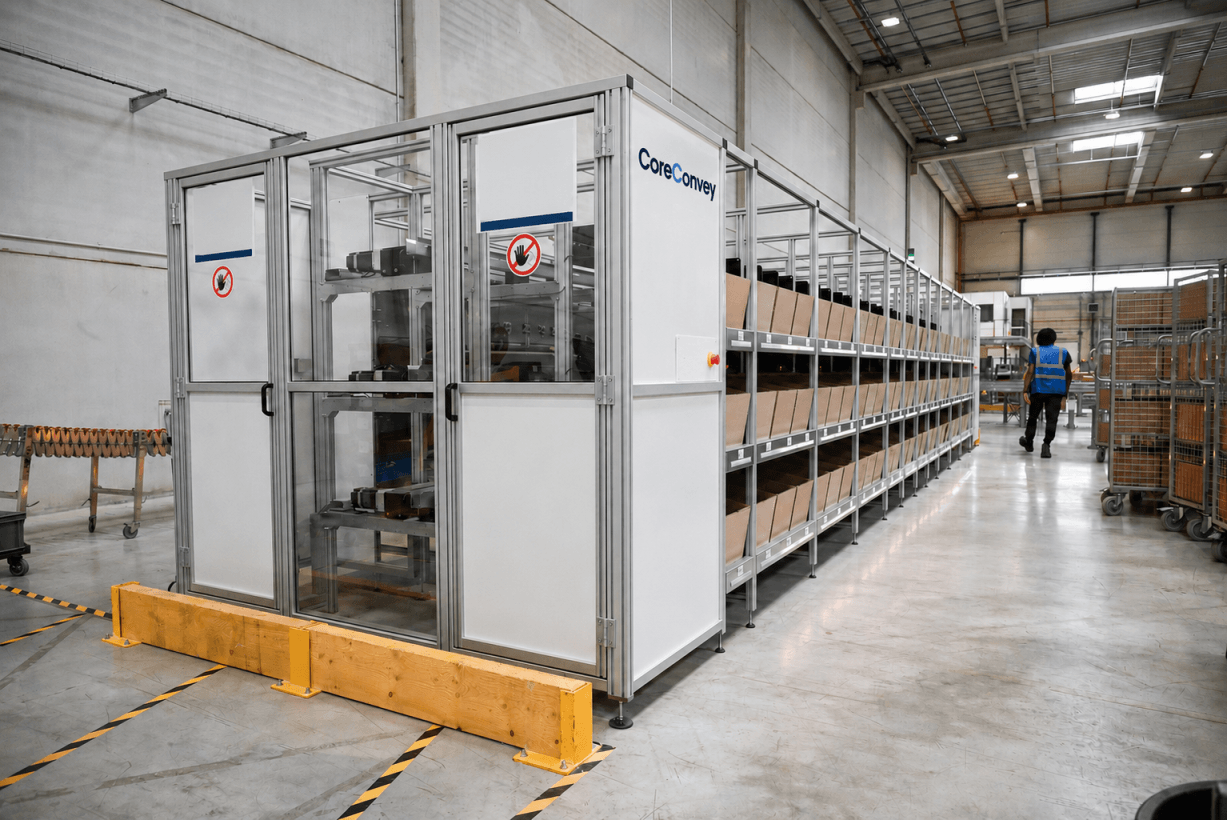
Create up to 50 outputs around one compact sorter instead of using a long, space-intensive conventional layout.
Expand without a big-bang project
Add destinations, adjust output formats or deploy additional coordinated units as volumes, routes or customers change.
Compact equipment, complete sorting process
CoreCompact brings induction, identification, routing and destination handling together within one modular platform.
The final configuration is developed around the parcel profile, hourly volume, number of destinations, output type, operator process and available layout.
- Manual or automated induction options
- Barcode reading and parcel verification
- Flexible bags, bins, boxes, cages or chutes
- Connection to WMS, ERP or customer platforms
- Single-unit or networked configurations
How CoreCompact works
Each item is introduced, identified and routed to the assigned destination using the connected control logic.
Induct
Introduce parcels manually or through an automated infeed designed around the required operating process.
Identify
Read the available barcode or item identifier and link the parcel to the relevant order, route or destination.
Verify
Capture images and relevant item data to support tracking, validation and investigation where required.
Route
Use the connected software and destination logic to determine the correct output for each item.
Sort
Direct the item into the assigned bag, bin, box, roll cage, chute or other configured destination.

Match the loading process to the operation
CoreCompact can support a straightforward manual induction process or form part of a more automated connected flow.
The right approach depends on how parcels arrive, the required hourly capacity, available labour, barcode orientation and the upstream equipment.
Capacity is an application result
Nominal throughput should always be assessed alongside parcel presentation, operator cycle, scan success, destination availability and downstream handling.
CoreCompact specifications
The values below provide an initial qualification guide. The final configuration and achievable performance depend on the complete application.
| Specification | CoreCompact |
|---|---|
| Nominal capacity | Up to 1,500 items per hour |
| Sort destinations | Up to 50 per unit |
| Starting footprint | Approximately 4 × 2 metres |
| Minimum item size | 75 × 50 × 5 mm |
| Maximum item size | 575 × 375 × 300 mm |
| Item weight | From a few grams up to 10 kg |
| Output options | Bags, bins, boxes, roll cages or chutes |
| Data capture | Barcode reading, image capture and parcel verification |
| System integration | REST API and FTP integration options |
| Expansion | Additional destinations or coordinated networked units |
Final capacity, footprint and parcel compatibility must be confirmed against representative items, destination arrangement, induction method, software logic and operator process.
Configure the outputs around the next handling step
The destination format should make the downstream process easier, whether items are being grouped for routes, customers, stores, returns or internal handling.

Controlled reusable destinations
Use totes or bins for returns, store orders, smaller destination groups or processes requiring durable reusable containers.

Simple changeable collection points
Use boxes or cartons where destination containers need to be exchanged quickly and moved directly into the next process.
Granular sorting for delivery networks
Sort by driver, route, locker area, local delivery point or another granular destination structure.
Adapt destinations to the product flow
Configure outputs for books, small items, returns and other defined product profiles where a compact sorter is a practical fit.
Output design affects the complete layout
Container dimensions, replacement frequency, operator access, fill monitoring and onward movement should be considered when the destination arrangement is developed.
Use one unit or coordinate several CoreCompact sorters
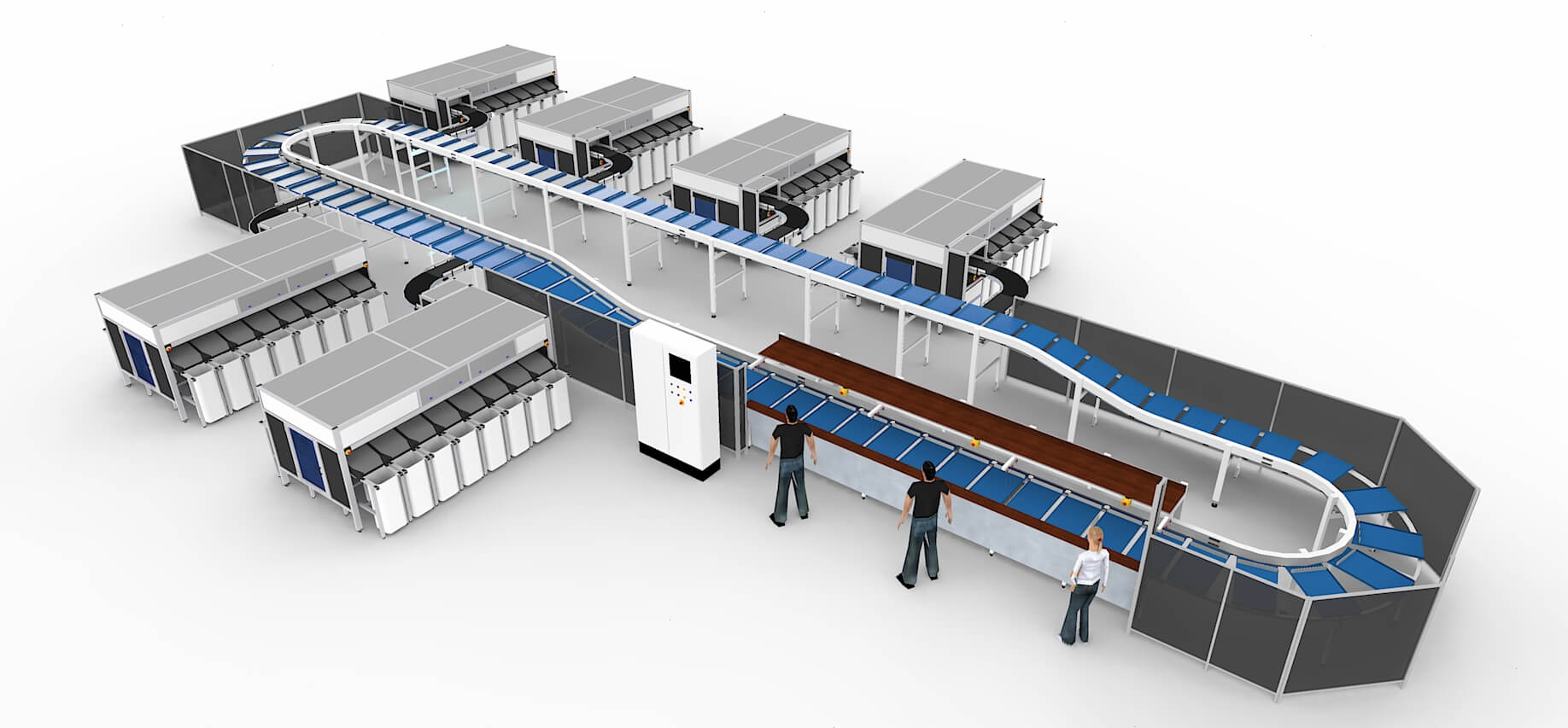
A focused requirement may need one unit. Larger destination structures can be divided between several units under central routing control.
Compact focused sortation
- Up to 50 destinations per unit
- One defined parcel or item flow
- Compact starting footprint
- Practical replacement for manual sorting
- Clear route for adding destinations later
More destinations and phased expansion
- Split destination groups across several units
- Coordinate routing through central software
- Separate customers, routes or parcel groups
- Increase combined handling capacity
- Expand in stages rather than one large project
Where CoreCompact can add value
CoreCompact is most relevant where many granular destinations must be handled within a controlled footprint and moderate throughput range.
Parcel-locker networks
Sort by locker area, driver, local route or delivery cluster before final-mile distribution.
E-commerce fulfilment
Group completed orders by carrier, service, route, cut-off or dispatch destination.
Third-party logistics
Separate items by customer, service level, destination group or downstream process.
Returns processing
Route returned items by customer, inspection path, product group or next required action.
Retail distribution
Sort store orders, replenishment items or parcels by branch, region or delivery route.
Books and small items
Handle defined small-item profiles where conventional high-speed parcel equipment would be excessive.
Is CoreCompact likely to fit your operation?
A clear fit assessment is more useful than forcing every application into the same product concept.
CoreCompact may be a strong fit where:
- You need many granular sort destinations
- Available floor space is restricted
- Items fit the supported size and weight range
- Current sorting is manual or difficult to scale
- Destinations change by route, customer or delivery point
- You want to expand in practical phases
- Identification and traceability are important
Another sorter concept may be better where:
- Required throughput is far above the intended range
- Products exceed the supported dimensions or weight
- The load profile is highly irregular or unstable
- Very high-speed continuous induction is essential
- The process requires pallet or large industrial-load handling
- A different sorter technology offers a simpler flow
Connect parcel decisions with physical sortation
CoreCompact needs the correct destination instruction, item identity and exception logic to route each parcel reliably.
- Import destination and routing instructions
- Link items to routes, customers or delivery points
- Exchange data using REST API or FTP
- Record item movements and parcel images
- Confirm successful sorting events
- Handle unreadable or unmatched items
- Coordinate several CoreCompact units

Plan for the parcels that do not follow the normal flow
A reliable sorting process needs a defined response when an item cannot be identified or a destination is unavailable.
- Unreadable or missing barcode
- Unknown or unmatched destination
- Oversized or unsuitable item
- Full output container
- Parcel requiring manual review
- Missed or failed sorting event
- Destination-container changeover
The required exception process is developed around the operational risk, staffing model and connected software.
Develop the layout around destinations, operators and future growth
CoreCompact can be configured as a focused standalone system or as part of a larger coordinated parcel operation.

Focused destination group
One sorter serving a defined process with clear access for induction, output handling and maintenance.
Tote-based operation
Destinations arranged around reusable containers for controlled internal movement and changeover.
Multiple destination groups
A larger coordinated layout for granular parcel routes, delivery points, customers or branches.
What information helps us assess CoreCompact?
You do not need every answer before contacting us, but representative parcel and process data allows a more useful first assessment.
- Item and packaging types
- Minimum and maximum dimensions
- Minimum and maximum weight
- Average hourly volume
- Peak hourly volume
- Required number of destinations
- Preferred output format
- Current sorting method
- Barcode or identification method
- Available floor space
- Existing WMS, ERP or platform
- Expected future growth
Support throughout the CoreCompact project
CoreConvey coordinates the equipment, controls, software integration and project delivery needed to turn the application into a working sorting system.
Understand and configure
We review parcel profiles, volumes, destination structure, induction, available space, operator requirements and system interfaces.
Install and integrate
We coordinate equipment delivery, installation, identification, controls, software connections, testing and commissioning.
Support and develop
Once operational, we can assist with troubleshooting, destination changes, software adjustments, maintenance planning and future expansion.
CoreCompact FAQs
How many destinations can one CoreCompact unit support?
One CoreCompact unit can support up to 50 individual sort destinations, depending on the selected output arrangement and project configuration.
What parcel sizes and weights can CoreCompact handle?
The stated item range is from 75 × 50 × 5 mm up to 575 × 375 × 300 mm, with weights from a few grams up to 10 kg. Representative products should be assessed before the final configuration is confirmed.
Can CoreCompact sort polybags and small packets?
Potentially, yes. Suitability depends on the bag material, shape, rigidity, label presentation and how reliably the item can be inducted and transported. Samples should be tested where the product profile is uncertain.
How are items loaded into the system?
Items may be introduced manually or through an automated infeed. The preferred method depends on volume, parcel presentation, available labour and the upstream process.
Which output types are available?
Outputs can be configured around bags, bins, boxes, roll cages, chutes or another suitable collection method developed for the downstream process.
Can several CoreCompact units work together?
Yes. Multiple units can be deployed in parallel or as a coordinated network, with central software assigning items and destination groups to the appropriate sorter.
Can CoreCompact connect to our WMS or ERP?
CoreCompact can support integration through REST API and FTP options. The exact interface and responsibilities should be defined during the project.
What happens if a barcode cannot be read?
The project should include a defined exception route or manual-review process for unreadable, unmatched or otherwise unsuitable items.
What determines the actual hourly capacity?
Actual capacity depends on parcel dimensions and presentation, induction method, operator cycle, scan success, destination availability, software logic and the downstream handling process.
Can the system be expanded later?
Yes. The destination arrangement and control concept can be developed around phased growth, including additional outputs or coordinated CoreCompact units.
Does CoreConvey install and commission CoreCompact?
CoreConvey can support application review, configuration, supply, controls, integration, installation, testing, commissioning, training and future development.
Let’s assess whether CoreCompact fits your operation
Send us your parcel profile, average and peak volumes, required destinations and available layout. We will review the application, identify any missing information and recommend a practical configuration or alternative approach.


