
Which parcel sorter is right for your operation?
Compare push, pop-up, swivel and cross-belt sorters by throughput, parcel profile, footprint and application. Then use the selector to identify the strongest starting point for your project.
The fastest sorter is not automatically the right sorter
Sorter selection depends on more than an hourly throughput figure. Parcel dimensions, product stability, peak profile, destination count, discharge design, available space and future growth all affect the answer.
This guide gives you a practical overview of the four main technologies available through CoreConvey. It is designed to help you narrow the field before we assess your parcel data and develop the full system.
Compare the four sorter types
Use this as an initial guide. Final performance depends on the item mix, system layout, infeed quality and operating conditions.
| Technology | Indicative throughput | Sort direction | Parcel range | Best suited to |
|---|---|---|---|---|
| Push sorter | Up to 2,000 items/hour | Single-side ejection | 150 × 100 × 5 mm to 1,200 × 800 × 600 mm | Simple, compact and cost-conscious sorting |
| Pop-up sorter | Up to 3,500 items/hour; potentially 5,000 for suitable products | Bilateral | 150 × 100 × 5 mm to 1,200 × 800 × 600 mm | Mid-throughput operations needing left/right diversion |
| Swivel sorter | Typically 5,000; up to 6,000 items/hour | Bilateral | 150 × 100 × 5 mm to 1,200 × 800 × 600 mm | Higher throughput with controlled electric diversion |
| Cross-belt sorter | More than 10,000 items/hour | Bilateral | Horizontal: up to 800 × 600 mm Vertical: up to 1,200 × 800 mm |
Large hubs, many destinations and sustained high volume |

Push sorter
A mechanical pusher moves the item sideways from the main conveyor into a selected lane or destination.
Push sorters provide a straightforward entry point into automated parcel sorting. They are compact, comparatively economical and suitable for operations where volumes and destination requirements remain manageable.
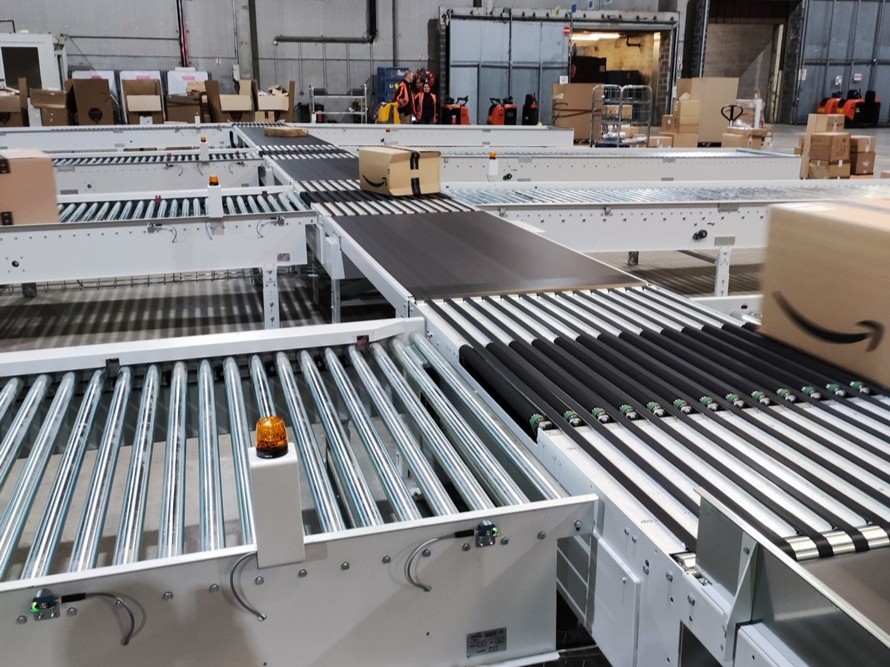
Pop-up sorter
A set of rollers or belts rises beneath the parcel and transfers it from the main conveyor to a left- or right-hand discharge.
Pop-up technology offers a useful step up from a simple pusher. Bilateral diversion increases layout flexibility, while modular construction makes the system suitable for growing operations.

Swivel sorter
Powered roller or wheel modules rotate to steer the parcel smoothly towards the selected side of the conveyor.
Swivel sorters provide fast, controlled and flexible diversion. The latest fully electric rotation system supports precision, energy efficiency and reduced pneumatic infrastructure.

Cross-belt sorter
Individual carriers travel around a loop, with a short powered belt on each carrier discharging the parcel at its assigned destination.
Cross-belt technology is designed for sustained high-volume sorting, large destination counts and complex parcel flows. Horizontal and vertical configurations allow the system footprint to be adapted to the site.
Parcel sorter selector
Answer five questions to see which technology is likely to deserve closer investigation.
Your indicative recommendation will appear here.
This selector provides an initial indication only. Final selection requires analysis of parcel data, peak profile, destination count, item stability, barcode performance and layout.
Four common starting points
Simple and economical
Lower volume, fewer destinations and single-side discharge.
Start with a push sorter.Balanced mid-range
Moderate volume with left- and right-hand diversion.
Start with a pop-up sorter.Fast and controlled
Higher throughput with precise electric steering.
Start with a swivel sorter.Maximum capacity
Sustained high volumes, many destinations and future expansion.
Start with a cross-belt sorter.Information we need to assess the application
Accurate input data prevents expensive assumptions and helps us compare the technologies on a like-for-like basis.
Where possible, provide both average figures and peak-period data. A parcel sample set or detailed item file is especially valuable.
- Average and peak items per hour
- Minimum and maximum parcel dimensions
- Parcel weight range
- Number of sort destinations
- Barcode type and label position
- Parcel surface and stability
- Available floor space and height
- Required accumulation method
- WMS, WCS or ERP environment
- Expected growth over 3–5 years
A complete parcel sortation workflow
CoreConvey can design the equipment and controls around the sorter so information and parcels move through one coordinated process.
Parcel sorter FAQs
Can sorter selection be based on items per hour alone?
What is the difference between a pop-up and swivel sorter?
When does a cross-belt sorter make sense?
Can these systems connect to our existing WMS or ERP?
Can CoreConvey supply the complete system?
Send us your parcel profile and we’ll compare the right technologies.
Include your peak throughput, parcel dimensions, number of destinations and any available layout drawings. We’ll use the data to identify the strongest technical and commercial route.


